Technical Concepts
Before diving into the implementation, it helps to understand what an OPRF is and how TACEO:OPRF extends it.
What is a Pseudo-Random Function (PRF)?
A Pseudo-Random Function (PRF) is a deterministic function that produces outputs that look random to anyone who doesn't know the secret key.
In practice, PRFs are implemented using:
- Block ciphers (like ChaCha or AES)
- Hash-based constructions (such as HMAC)
Given a secret key k and an input x, a PRF deterministically computes:
F(k, x) → random-looking value
What is an Oblivious PRF (OPRF)?
An Oblivious PRF (OPRF) is a special kind of PRF computed jointly by two parties:
- Client: Provides the input
x - Server: Holds the secret key
kand evaluates the function
The key property is mutual privacy:
- Client never learns the key
k - Server never learns the input
x
How TACEO:OPRF Extends This
TACEO:OPRF builds on the OPRF design with threshold security:
- The secret key
kis secret-shared across multiple parties - No single party can evaluate the PRF alone
- A threshold of parties must cooperate
- Provides MPC trust guarantees while keeping inputs and keys private
Architecture Overview
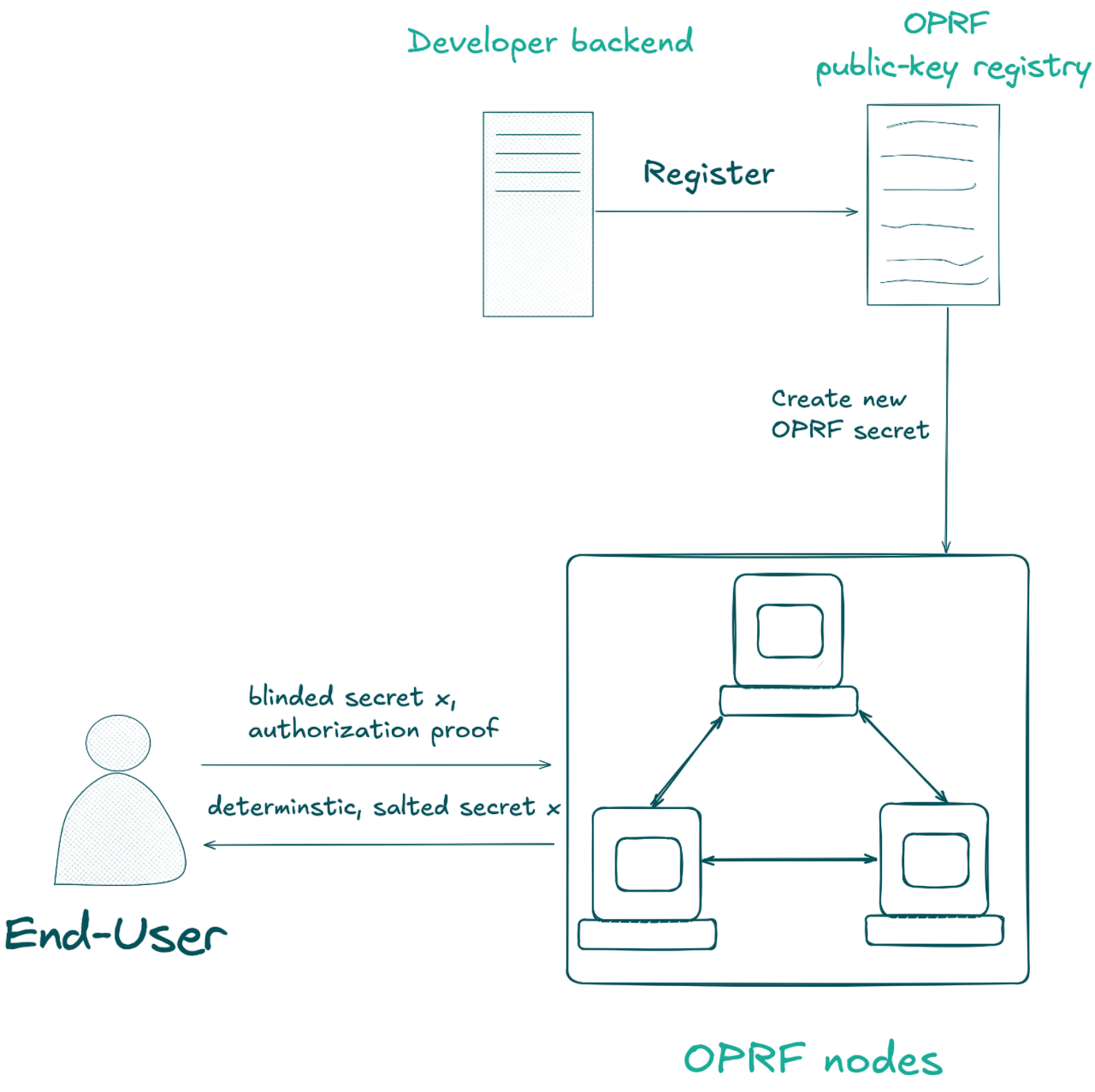
The TACEO:OPRF architecture consists of:
- Independent OPRF nodes that hold shares of the OPRF secret key(s)
- On-chain public registry of corresponding OPRF public keys
- Authorized accounts that can trigger secure key generation
Standard Protocol Flow
Here's how a user interacts with TACEO:OPRF:
1. Query Generation
The user generates a blinded OPRF query and produces an authorization proof.
2. Node Processing
OPRF nodes:
- Receive the query
- Verify the authorization proof
- Contribute with their key-share
3. Response Aggregation
The client:
- Receives responses from threshold-many nodes
- Combines answers into the full OPRF output
4. Optional Proof Generation
The client can prove valid OPRF execution in a ZK proof and submit both the output and proof to a verifier.
Key Security Properties
Privacy
- Input privacy: Your secrets are never revealed
- Key privacy: No single node knows the complete key
- Computational privacy: Intermediate steps remain hidden
Integrity
- Threshold security: Requires cooperation of multiple honest nodes
- Verifiable computation: Results can be proven without revealing inputs
- Authorization enforcement: Custom eligibility requirements
Flexibility
- Custom authorization: Implement project-specific access control
- ZK-friendly design: Compatible with zero-knowledge proof systems
- Multi-use keys: Support multiple OPRF instances per authorization module
Further Reading
For deeper technical details: